|
GF Handel
Op. 2 Trio Sonatas
London Handel Players
Rachel Brown flute & recorder
Adrian Butterfield & Oliver Webber violins
Katherine Sharman cello
Laurence Cummings harpsichord
Sonata No1 in B minor
Sonata No2 in G minor
Sonata No3 in B flat
Sonata No4 in F
Sonata No5 in G minor
Sonata No6 in G minor
Producer: Siva Oke
Recording Engineer: Ben Connellan
Location: St Mary’s Church, Walthamstow, London
27-29 November 2007
SOMMCD 084 DDD
£12 plus postage and packing
£1.50 (UK), £4 (Europe and overseas) |
The London Handel Players have already served their eponymous master admirably in the Op.5 Trio Sonatas. Now they turn their gaze on a set more likely cobbled together by the wily publisher John Walsh - plundering a cache of music from Handel's 'Chandos' years, as well as a piece 'Compos'd' - if the librettist of Messiah is to be believed - 'at the age of 14'. There's inevitably a stylistic and qualitative unevenness, but Walsh contrived an attractive collection - already persuasively recorded by Sonnerie and (in a bargain box of the 'complete' chamber music on Brilliant Classics), L'Ecole d'Orphée. What the London Handel Players bring to the table is a crystal-clear recorded sound which lends a thrilling immediacy to textures which themselves are always elegantly enunciated.
Sonatas nos.1 and 4 benefit from the expressive eloquence of Rachel Brown's flute, and in the opening Andante of the B minor, she and Adrian Butterfield converse with flirtatious suppleness - the ravishing Largo her chance to soar like a Handelian operatic diva. The chattering animation of No.2's first Allegro fingers Buxtehude; mindful of other backward glances in the sonata the Players ornament accordingly, and they give the Finale a pugnacious presence to compensate for its lack of compositional sophistication. The Sixth Sonata receives a slightly austere reading, but, tenderness to contrapuntal trenchancy, London Handel Players tick most of Op.2's multifaceted boxes - and then some. Paul Riley, BBC Music Magazine, Christmas 09 (Handel Trio Sonatas Op.2)
The London Handel Players' recording of the first of their namesake's two published sets of trio sonatas differs from rival versions in mixing up the scoring, though not as much as the cover promises: Rachel Brown is credited with playing flute and recorder (and indeed is pictured on the cover holding both instruments) but, unless my ears have deceived me, there is no recorder to be heard here. Never mind though - her contribution in Sonatas Nos 1 and 4 is a delight. It cannot be denied that what should be an equal relationship between treble instruments in a trio sonata texture is knocked a little off-balance when the pairing is flute and violin (one's ear is always drawn to the flute), but when the playing is as gently breathed and musically refined as the kind Brown has to offer, there can be no reason for complaint. The First Sonata in particular emerges here with a Gallic exquisiteness of gesture to match that of a Couperin or a Marais.
The remaining sonatas are given the more conventional two-violin treatment, and sound well on it too. Adrian Butterfield and Oliver Webber do not have the lyrical grace of Sonnerie, but there is perhaps more clarity of texture here, and their playing is stylistically confident, with plenty of intelligent interpretative detail to entertain the ear. The continuo section manages to be both punchy and resonant - a bold sense of line from Katherine Sharman, rich chords from Laurence Cummings - and the pair are not afraid to take centre stage when the time comes to stride around like pocket-Polyphemuses in the Larghetto of the Third Sonata. These are fine performances from players who really know their ground. Lindsay Kemp, Gramophone, July 09 (Handel Trio Sonatas Op.2) |
"In September 2005, I was much taken with a recording of Handel's Trio Sonatas, Op.5 from this same source. Now, the London Handel Players, with exactly the same recording team, in the identical venue, have come up with equally delectable results in a further set of Trio Sonatas, this time known as the composer's Op.2.
Adrian Butterfield, violinist with the London Handel Players, supplies an excellent note with this recording, in which he makes it plain that the 24 movements making up Op.2 were very likely written at widely different times in Handel's life. He adds that the fact that many of them exist in other shapes and guises only contributes to the confusion, as it is often hard to know which came first, the Handelian chicken or the Walshian egg! There are adaptations or parodies here of, for instance, the operas Rodelinda and Rinaldo, the oratorio Esther and at least one Chandos Anthem: in his way, Handel was as much of a borrower as Bach.
Maybe none of that matters, in the face of such delightful music as results, whether it was pressure of time or some other form of expediency. From the moment Rachel Brown's delicately warbling wooden flute begins the pastoral Andante that opens the B minor Sonata that is first on the disc, one simply surrenders. Ben Connellan, the recording engineer, conjures the ideal sound from the church in Walthamstow that is the chosen location.
The performers take some eminently sensible decisions about what instruments to use from the available options (flute or recorder or a second violin, above the continuo line) depending on lay-out, suitability, the need for a little variety, and so on. Cadential points are embellished with always suitable decorum. The low pitch adds an indefinably touching quality of gentleness. The single manual harpsichord is properly perceived as a quiet instrument - it so often isn't, when recorded - and the balance between the instruments is impeccable. Everywhere there are things to enjoy, with some especial moments of Handel's magic wand: the touching Largo from the G minor Sonata No.2; the chaconne-like Larghetto from the B flat Sonata No.3; the wit of the final Allegro from No.4 in F.
I could go on. I won't. Lovers of Handelian affettuoso in particular need not hesitate." Piers Burton-Page, International Record Review, May 09 (Handel Trio Sonatas Op.2) |
|
GF Handel
Seven Trio Sonatas, Opus 5
London Handel Players
Rachel Brown flute
Adrian Butterfield & Oliver Webber violins
Peter Collyer viola, Katherine Sharman cello
Laurence Cummings harpsichord/organ
Producer: Siva Oke
Recording Engineer: Ben Connellan
Location: St Mary's Church, Walthamstow, London
Released in April 2005
SOMMCD 044 - SOMM Recordings
£12 plus postage and packing
£1.50 (UK), £4 (Europe and overseas)
Cheques to be made payable to London Handel Society |
The performances are uniformly excellent: they have the straightforward integrity that is essential for Handel, and yet they are full of delicacy and refinement.”
Peter Holman, Early Music, May 2006 (Handel Trio Sonatas Op.5)
"I find all the performances well-nigh perfect...the music is absolutely gorgeous".
Piers Burton-Page, International Record Review (Handel Trio Sonatas Op.5)
“The London Handel Players shine in immaculately prepared, finely balanced and lyrical performances.”
David Vickers, Early Music Today, August/September 2006 (Handel Trio Sonatas Op.5) |
GF Handel
Complete Violin Sonatas
Adrian Butterfield violin
Katherine Sharman violoncello
Laurence Cummings harpsichord
Released in November 2007
SOMMCD 068 - SOMM Recordings
£12 plus postage and packing
£1.50 (UK), £4 (Europe and overseas)
Cheques to be made payable to Adrian Butterfield |
“I thoroughly enjoyed listening to this disc several times through. Adrian Butterfield plays beautifully throughout and is lent wonderful support by Katherine Sharman and Laurence Cummings. This should be required listening for anyone playing these works.”
Brian Clark, Early Music Review, February 2008 (Handel Violin Sonatas)
Butterfield, Sharman and Cummings have gathered together on one disc all those works for violin and continuo that are indisputably by Handel, and as a welcome bonus include the first recording of an Allegro for solo violin in G, HWV407, a one-minute charmer of running semiquavers discovered on the spare staves of a discarded violin part for Serse.
Piers Burton-Page welcomed the London Handel Players’ Somm account of Handel’s Op.5 as “well-nigh perfect” (September 2005), a view from which I would not dissent regarding the current issue. I can still vividly remember playing the Allegro finale of HWV361 as an 11-year-old student (plenty of boyish enthusiasm if hardly the last word in technical finesse), so to hear Butterfield’s subtly nuanced, light-as-air reading came as a special revelation. That could be said for everything in this richly enjoyable recital, which tellingly places the seven-movement D minor Sonata, HWV367 at its expressive core. Here these three outstandingly gifted players are at the peak of their collective form, pouncing on the third movement Furioso with gleeful abandon and stunning virtuosity (a special word of praise here for cellist Katherine Sharman’s staggering agility). There is lovely sound, too, from Siva Oke and Ben Connellan.
Julian Haylock, International Record Review, March 08 (Handel Violin Sonatas) |
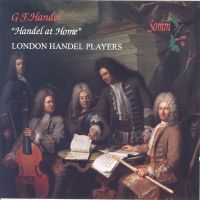
Handel at Home
Premier recordings of this Handel Flute Concerto and aria arrangements for flute, strings and harpsichord from Alcina,
Solomon and Semele.
London Handel Players
Rachel Brown flute
Adrian Butterfield violin
Oliver Webber violin
Peter Collyer viola
Katherine Sharman cello
Laurence Cummings harpsichord/organ
“This extremely attractive release is sure to find a wide audience; it’s as much fun as it is beautiful.” Robert Levett (IRR)
Producer: Siva Oke
Recording Engineer: Ben Connellan
Location: St Mary’s Church, Walthamstow, London on 16-18 November 2005
SOMM Recordings
Catalogue number SOMMCD 055 DDD
£12 plus postage and packing
£1.50 (UK), £4 (Europe and overseas) |
 |
“This review could be reduced to just three words: ‘Buy this recording’. In the eighteenth century the London publisher John Walsh produced arrangements for home performance of excerpts from the hugely-popular Handel operas. On this disc Rachel Brown and the London Handel Players give performances that are perfection itself, with a dazzling beauty of tone and of phrasing, a breadth of colours and a range of dynamics that are employed to serve the music and to entertain the listener.”
Robert Bigio, Pan (British Flute Society Magazine), September 2006 (“Handel at Home”)
Their consummate musicianship is consistently delightful: sparkling violin-playing (often with two players in perfect unison) and superb continuo contributions are just as impressive as Brown’s poetic solos.”
David Vickers, Gramophone Magazine, September 2006 (“Handel at Home”)
The performances are eloquently persuasive throughout. The London Handel Players produce rich and varied sonority, rendering the music with energetic vitality, lilting elegance and affecting beauty. They display a level of musical sensitvity, refinement and vigour that would be equally welcome in renditions of the original versions. The more lyrical numbers are especially moving.
Uri Golomb, Goldberg Magazine, March 08 (“Handel at Home”) | |